|
when fishes flew and forests walked
As a child, I
spent many weeks a year in North Wales with my grandmother. She was friends
with an elderly gentleman who suggested that I might enjoy visiting his
railway. A special train was run with the most decrepit coach and locomotive
I had ever seen. Progress was to say the least, ambulatory and after a while I
remember getting bored and began to poke my finger through the rotten wood of
the carriage until Nana caught me!. The whole ramshackle affair at Towyn reminded me of the Roland
Emmett railway at the Festival of Britain.

Tal-y-Llyn pre-preservation
I
quickly discovered that there was also a derelict line at Portmadoc.
My cousin and I cycled up to Boston Lodge and 'gained entry' into the
buildings and viewed the desolation. Only a few years later, Prince was
hauling a few coaches across the Cob, and during one of my visits, I even managed to catch a very cold
ride behind the Simplex through the old tunnel to Festiniog.

the real Moelwyn tunnel after closure
My mother used
to tell me about the nightmare journeys she sometimes endured returning home
to Barmouth from university in Bangor. My family had free passes for the WHR
so she would change at Dinas and
travel to Minffordd and pick up the main line again! On one occasion, she spent a very
cold night somewhere between South Snowdon and Beddgelert as the 'tiny
engine' called 'Palmerston' had broken down and no other was available until the next morning.
She well remembered the 'Gladstone Car' which she froze in during the night.
She found it difficult to imagine how such an awful railway was associated
with two prime ministers! On another occasion, the 'American' engine broke down and
the driver broke his foot kicking old 590 into submission while abusing it in
Welsh and pure Anglo-Saxon! My mother would always say that the invective did
not bother her at all as she was reading Anglo-Saxon at Uni!
Unsurprisingly, her view of the Welsh
Highland was a tad jaundiced! She had family in Festiniog and would often
visit using the Festiniog Railway, having taken the Cambrian to Minfordd
exchange station. I am not sure whether she actually realised that in the
end, the WHR and the Festiniog were one and the same.

the butchered Russell with the 'Gladstone Car'
I also had an aunt who owned
a hotel
in Ilfracombe and she told me of the wonderful little train that used to run
near there. For a while she had something going with one of the loco drivers. She had stacks of photos of the L & B
but never landed the driver and ended up as a rather wealthy old maid with a talking budgie.
Unlike the stories my mother told of the Welsh Railways, my aunt only spoke
of the L&B with affection and it appears that it had never let her down. I
decided that this had to be the best!
Hooked on narrow gauge, I
built a large 008 layout in the late 1950s, after being inspired by Ahern's
books and Hancock's periodic articles. Aberglaslyn Pass was heavily featured. The
only loco, a double Fairlie, was scratch built in brass and
employed a Lone Star motor driving through UJ shafts. I managed to persuade a
clockmaker to make it for me if I repainted his Moggie Minor. The whole affair worked very well
at scale speeds, thanks to spur gears and the detail and finish would stand
muster today. Actually, it ran like a clock!
I now realise that
I must have been one of the first doing this sort of thing. I wish I still
had this engine but I swapped it for an 1936 MG Pa which was far better for
getting girls!
Whilst in
Colorado Springs in the '70s, I was able to find the time to build some locos
in silver. 009 was chosen this time as by then, N gauge had become quite
popular. I made many components by photo etching. I was a member
of the Denver Model RR Club which had a layout at the Golden Railroad Museum, where everything is weathered to the nth degree.
Even now, our models are more weathered than is usually seen in the UK. I remember an Xmas
competition for the best weathered children's' toy. My son was not best
pleased with his ride on tractor!
Aviation, sailing and other activities
(such as work) occupied the intervening years. The locos, packed in boxes, have visited most of North America,
the Caribbean and Europe. They even made 4 trans-Atlantic crossings in small
yachts before finally coming to rest near Ludlow in the UK! Amazingly
they still work! Only now have I been able to take them out and
begin to build the rest of the railway. We have decided to concentrate on the L & B as we feel the Welsh
lines are being done to death. The L&B also appeals as it was in effect a
'big railway' on narrow tracks.
After some consideration
we have decided to model a freelance section of the L & B
as this offers a greater degree of creative opportunity. There was a
scheme to extend the line onwards to Minehead. Indeed, the route was
actually surveyed. We have built the intermediate station of County Gate
on this projected extension, where the
branch from the harbour meets the main line. The fictitious history of the
railway is partially true. There really was a Glenthorne Estate near
County Gate built by Halliday and coal was actually offloaded onto a beach from ships
close by. We apologise for any offence the distorted
history may give; it is unintended.
Jenny is a fine arts graduate and used to be
involved in the stage design for Pink Floyd and Rolling Stones and worked as an artist on the
Beetles cartoon 'Yellow Submarine'....trains leave her
cold but she loves scenic dioramas. John is more interested in the
railway aspect but also prefers making buildings and scenery. Both John and
Jenny were pilots until age got the better of them (John still holds an
absolute World Air Speed Record taken in an aircraft built by him) and loves music and oriental cats (despite
the cat jokes on this site!). If you would like to hear some of John's music,
click here.

We would like to thank:
Malcolm Alberry for the design of the Loconet installation and automation
DCC supplies
CML Electronics Limited
Hereford Model Shop
Backwoods Miniatures
Neil Moss for his wonderful artwork for coach etchings
Peter Wallace who now builds our chassis and without whom we would have a lot
of dysfunctional locos!
Tony Freestone for panelling and lining the locos
Townscene for the excellent plaster mouldings used at the harbour.
Peco and its offshoots for so many excellent products
and the Desperados, the team
who selflessly give their time to help run CG at exhibition
those that inspired
P.D.Hancock for his inspirational articles on his Craig
and Mertonford Railway back in the 1950s. We later learned that the C&M did
not run as well as it might!
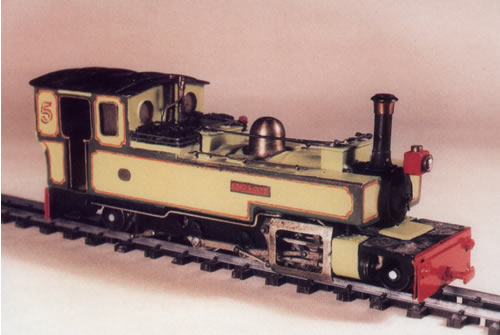
P D Hancock's 'Alastair' based on a Lynton and
Barnstaple Manning Wardle. It is a bit oversize in order to accommodate the motors
available at that time.
J Ahern (Madder Valley
Railway) who wrote the series of books on how to model railways properly when
3 rail Hornby Dublo and Lionel was more the norm.
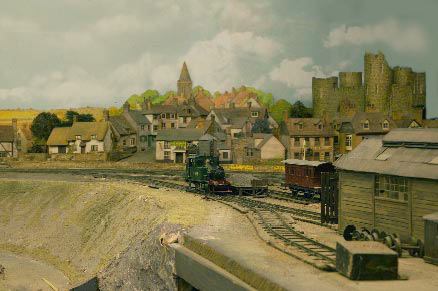
Madder Valley Railway (Now at Pendon Museum)
Jack Nelson who taught us about
perspectives
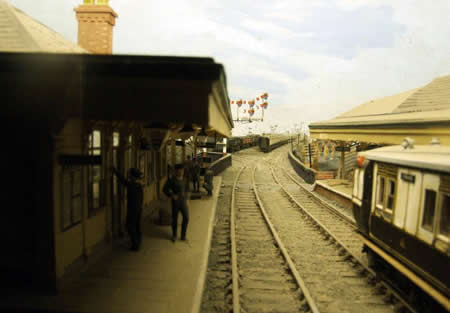
Part of a Jack Nelson diorama at
Betws-y-Coed Railway Museum
photo by Chris Brooker
and finally, Doris and Iliffe Stokes who were the very
first, in my opinion to make model railways 'atmospheric'.

|