|
the 009
locomotives of County Gate
County Gate being a 'what could have been'
extension of the Lynton and Barnstaple needed accurate and detailed models
of the L&B locomotives, 'Lew', 'Taw', 'Exe', 'Yeo' and 'Lyn'. We used
kits supplied by Backwoods miniatures.
With the exception of No 759 'Yeo', we have selected the lighter Malachite SR
green rather than the original 'dark olive'. During the weathering
process, the locos are finely sprayed with dark grey and this brings the
colour back down towards SR 'Olive Green'.
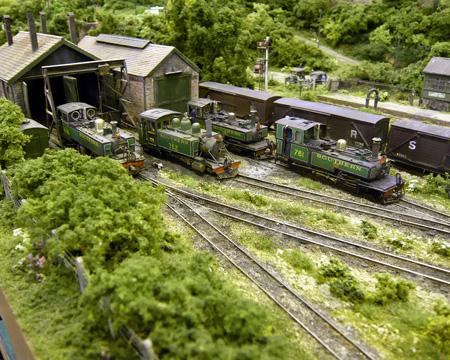
some of the 'girls' have a
get-together
- click on image to enlarge
One problem in these small gauges is to get
acceptable running for many differing locomotive types. As an example, we
find that our Garratt locomotive shows 'P' factor when running. That is,
the rotation of the universal drive causes the articulated chassis to bias
to one side or another which causes derailment on turnouts unless the
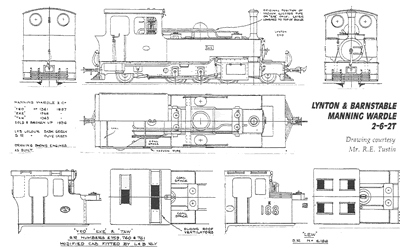
check rails are perfectly set. The 2-6-2 Manning Wardles on the other
hand, have long rigid wheelbases which can get tight on point
checkrails. On County Gate, we have to get the check rails to within one
thou. to get reliable operation for both types of loco.
Another problem is the variation in
performance of locomotives. When I built the first two sections of County
Gate, I was still living in the dark ages and wired the railway for DC
(they still switch on light bulbs with a match in Herefordshire). Having
seen what can be done with it, conversion to DCC began during the winter
of 2007. Each loco can be programmed to give predictable and
consistent performance. In addition, the track voltage is a steady 15V AC
so dirty track is less of a problem. At long last, we are blasting into
the 21st century! The final programming of locos is a very difficult and
complicated task and this work continues.
Locomotives on County Gate must be able to
withstand a hard working life and therefore need to be reliable long term.
They are expected to run long distances (compared to many layouts) and
haul heavy stock over grades. Gradually, we are learning what is required
to obtain these characteristics. These days, all coupling rods are fitted
with brass bushes and many other small modifications are included. Running
qualities are much improved if current is also taken from the pony trucks.
Building a model railway is about personal
choice. We all have our priorities and the results of our modelling shows
how really different we all are. My personal bugbear is the practice of
slinging inside framed chassis under prototypes which were outside framed.
Backwoods Miniatures fortunately have brought out some fine, accurate
kits, but the chassis can be exceptionally difficult to build. I must
confess that they are beyond me and I have to pay others to build them for
me. I have no trouble building the bodies. The design of the Backwoods
chassis makes any replacement or repair very difficult.
Our loco 'Taw' had a chassis built by a
'professional' who did not have a clue and despite many visits to Peter
Wallace, was never a good performer. For this reason, we have converted it
to include the new Grafar/Bachmann N gauge 008 chassis and this appears to
be very successful. The loco has less traction, however due to the plated
wheels.
To establish 100% reliability, we now mate
the L&B locos with a companion vehicle which also collects current. The
improvement in performance is outstanding.
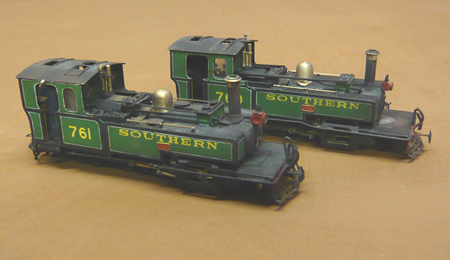
two of our Backwoods Manning Wardles
All our locos are now flywheel fitted except
the 4-6-0 Baldwin and 'Lyn' where room was not found.
|
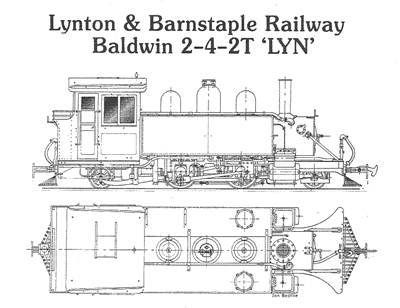
Lynton and Barnstaple locomotives |
click for full size image
click for full size image
Here are some of the
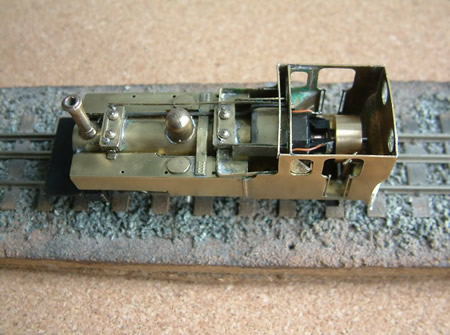
stages when building a modified Backwoods Manning Wardle (in this case 'Yeo')
photos Peter Wallace.
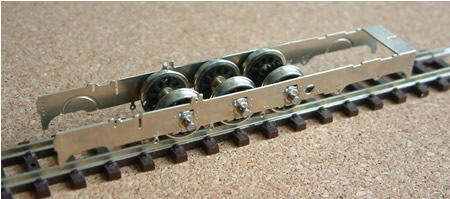
the start of the chassis for 'Yeo'
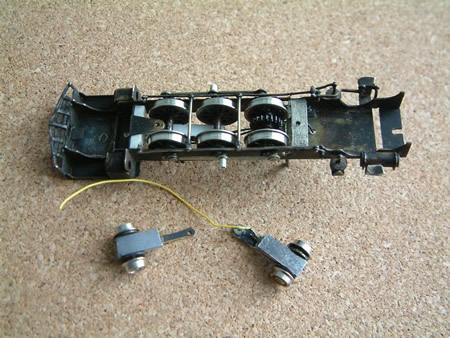
pony trucks weighted and wired - click on
image to enlarge
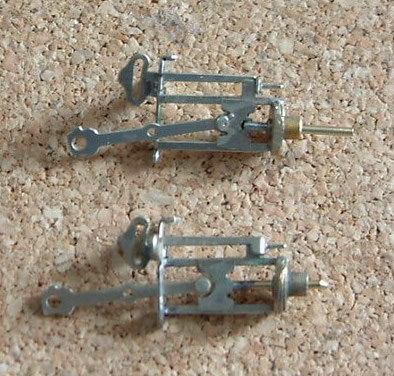
slidebars soldered to cylinder covers and
crossheads fitted - there must be no play in the crossheads
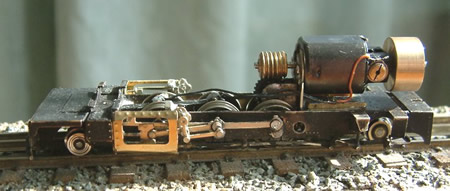
rolling chassis wired and completed
- click on image to enlarge
motor and flywheel fitted
- click on image to enlarge
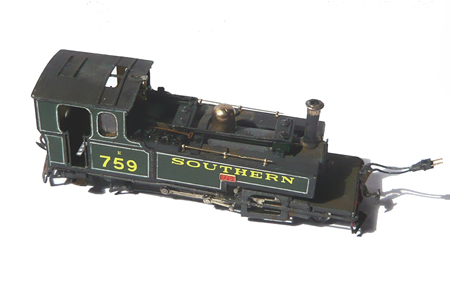
the
completed 'Yeo' wired for connection to 'companion coach' - click on image
to enlarge
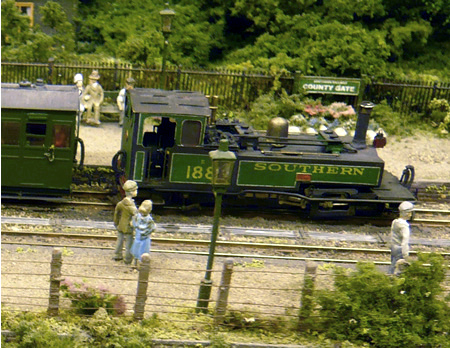
Lew
Lyn is to be built again for the rebuilt
Lynton and Barnstaple Railway.
Click here for
more details
_450.jpg)
chassis of 'Lyn' - Peter
Wallace
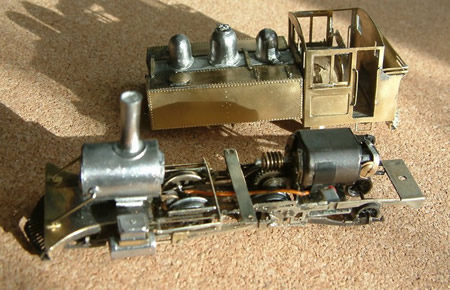
'Lyn'
dismantled
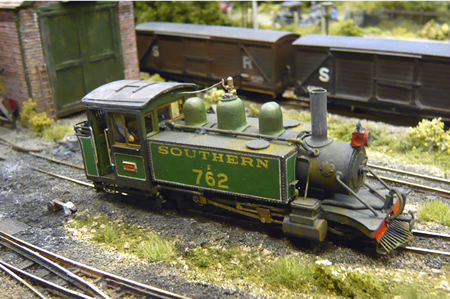
the completed 'Lyn' - click on image to
enlarge
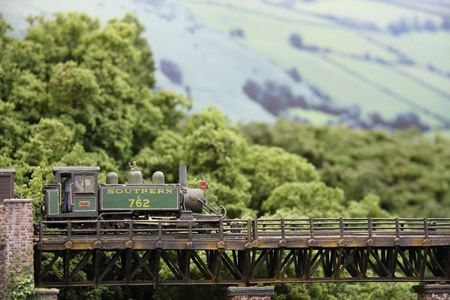
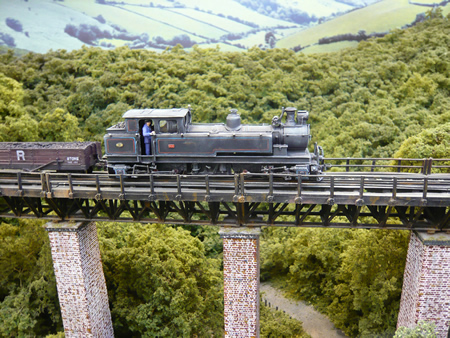
'Lyn' creeps onto the East Lyn viaduct-
click on image to enlarge
In addition to these locos, we have also
built four freelance models that could possibly have existed had the
extension been built. These have indeed added more variety and interest
during exhibition running.
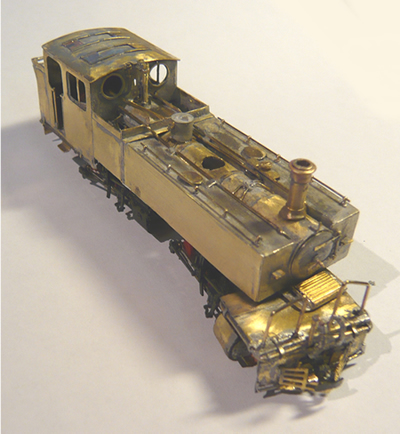
the Mallet under construction
Following a joke about articulated
locomotives for the L&B on the Yahoo forum, I drew a Lynton and
Barnstaple Mallet. If traffic had been heavier, the design would have
been much more economical than double heading. The locomotive remains
within the loading gauge and would have negotiated the curves. The
locomotive number tells it all, (the number of the Beast). It is called
'River Avon' or the 'Mad Mallet'. It is a 'kitbash' of a Backwoods
Manning Wardle and is fitted with two modified Grafar class 8 outside
frame chassis with Roco valve gear and cylinders.
The motors are jointly controlled by a Digitrax DZ 143 chip.
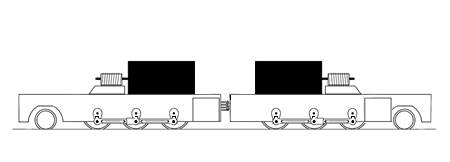
Originally, I used Roco chassis but they
failed very quickly due to their poor design.
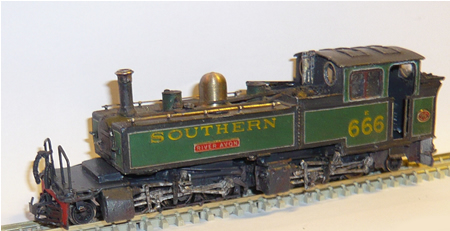
the Mallet loco 'River
Avon'
A second Mallet has also been built, 'River Brue' which is also based on
two outside frame Grafar class 8 chassis. The loco represents a
development of 'River Avon' and is built to the maximum loading gauge
permissible on the Lynton and Barnstaple.
The valve gear was supplied by Backwoods, (from their Russell kit). The
motors are now controlled by a Digitrax DZ 125 chip. The loco is
fitted with working lights.
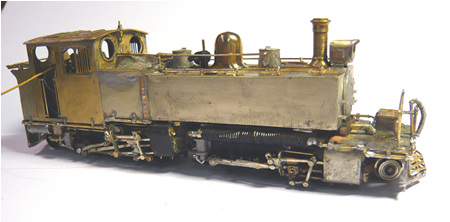
'River Brue' No 667,
prior to painting. It has working lights.
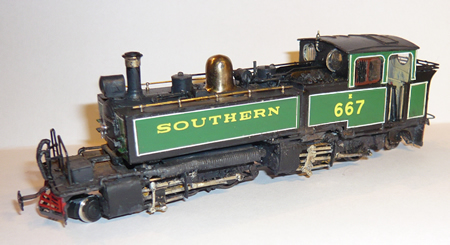
'River Brue' will
retain its 'out of the paint shop' finish
|
railcars Nos 200, 201,302 and 304 |
These are freelance
models of 'art deco' style diesel electric railcars that could have been
built during that period. The units are very popular with the younger
set who are fixated with modern image railways. They run exceptionally
well and being articulated, weave through the points in a compelling
manner. They are all fitted with lights and the wiring between the units
makes them difficult to put on the tracks. The silver railcar shown here
is now withdrawn as an attempt to use burnishing silver paint was a
disaster.
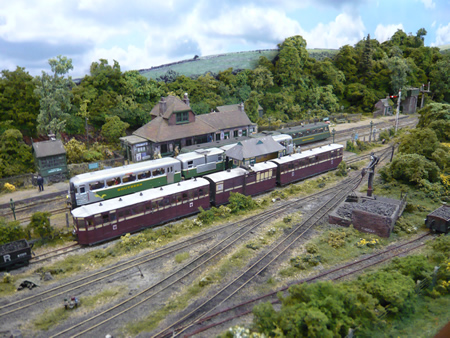
the main line prototype railcars cross, while the Glenthorne unit stands in the bay
platform
The last railcars built are our thoughts on
how Eastleigh, following the experience of the prototypes, would have
built a series of these beasts to replace the aging carriage stock and
steam locos.
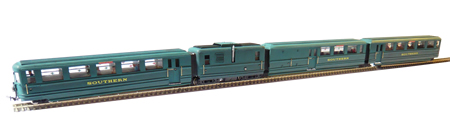
First Eastleigh built production railcar
No 202 - click on image to enlarge
|
the
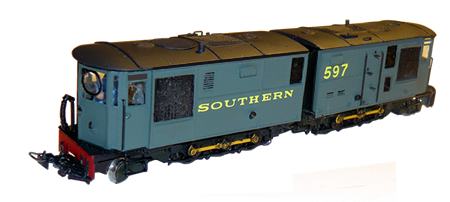
future? No.597 'River Avill' |
The success of the railcars prompted
Eastleigh to consider the use of heavy diesel electric traction units to replace
the elderly steam locos. A prototype unit was delivered by Armstrong
Whitworth in 1935 for trials. Our model is based on two Grafar class 08
chassis.
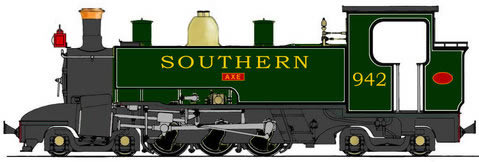
A new locomotive which is still under
construction is a Baltic tank 'Axe'. It is an exercise in how North
British would have designed a loco for the L&B if they had supplied one
for the Minehead extension. The chassis has been designed and built by
Jeff Bissonnette and benefits from high tech construction methods such
as laser cutting. The chassis is is fully compensated.
Southern
Railway locomotives built for County Gate:-
|
Taw |
761 |
2-6-2T |
Backwoods kit |
b - J de Frayssinet c - Grafar/Backwoods
l - Tony Freestone |
|
Exe |
760 |
2-6-2T |
Backwoods kit |
b - J de Frayssinet c - rebuilt by
Peter Wallace l - Tony Freestone |
|
Yeo |
759 |
2-6-2T |
Backwoods kit |
b - Peter Wallace c - Peter
Wallace l - Tony Freestone |
|
Lew |
188 |
2-6-2T |
Backwoods kit |
b - J de Frayssinet c - Peter Wallace
l - Tony Freestone |
|
Lyn |
762 |
2-6-2T |
Backwoods kit |
b - J de Frayssinet c - Peter Wallace
l - Tony Freestone |
|
River Avon |
666 |
2-6-0-0-6-2T |
freelance Mallet |
b - J de Frayssinet c - modified
Grafar chassis l - Tony Freestone |
|
River Brue |
667 |
2-6-0-0-6-2T |
freelance Mallet |
b - J de Frayssinet c - modified
Grafar chassis l - Tony Freestone |
| |
200 |
prototype diesel/electric railcar |
b - J de Frayssinet c -Grafar l
- Tony Freestone |
|
Atlantic Airstream |
302 |
production diesel/electric 3 coach railcar |
b - J de Frayssinet c -Riverossi
p - JdF |
|
La Coupe D'Or |
304 |
production diesel/electric 4 coach railcar |
b - J de Frayssinet c -Bachmann
p - Chromed Up |
|
River Avill |
777 |
prototype articulated diesel electric
traction unit |
b - J de Frayssinet c -Bachmann class
08 |
|
Axe * |
942 |
4-6-4T freelance North British |
b - J de Frayssinet c -Jeff
Bissonnette l
- Tony Freestone |
b body builder
c - chassis builder
p - painter
l - lining
* under construction
|
Glenthorne Harbour locomotives |
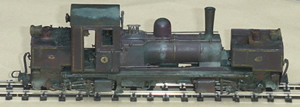
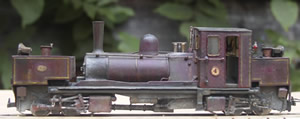
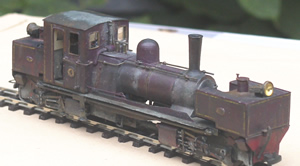
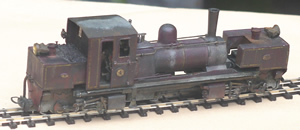
I built the locomotives shown below in the
70s. Very little was available then and I had to struggle hard to get them
to work well. The prototypes are Welsh orientated but we have found an
excuse for them to make an appearance by having the Glenthorne harbour
branch!
click on image to enlarge |
click on image to enlarge |
click on image to enlarge |
click on image to enlarge |
|
This was the hardest thing I think I ever made
in miniature! The basis was an N gauge diesel loco. The motor is central and
drives the bogies by lay shafts with universal joints. Axles extenders were
made and fitted using a jig. I did artwork which was the basis for photo
etching the parts at the nearby Beech Aerospace division (they did this in
between the times they were building exploding cryogenic tanks for Apollo
13!). The loco is very powerful but solder joints have got a tad brittle and
I have had to do quite a bit of servicing. I actually brought it to the UK in
the 70s to a Wessex 009 group meeting.
The loco has now had a major
overhaul and has been fitted with a flywheel which has much improved its
running qualities. It is one of the mainstays for operating coal trains out
of the harbour.
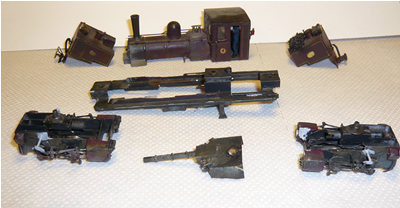
stripped for flywheel fitting (click to enlarge)
|
Hunslet No1 (in memoriam) |
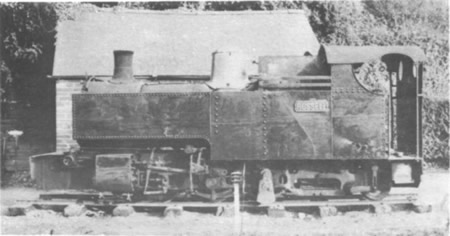
a butchered Russell on arrival at Towyn
(N.J. Allcock)
I first met Russell when he
lived behind the Buildings at Wharf Station of the Tal-y-llyn. He was painted
pea- green and was squat and ugly after the pointless attentions of the
Festiniog Railway. I took many photos and measurements and these were the
basis of the model I made. In many ways, it was the best of my efforts,
having had the benefit of the experience gained in building the others. It
ran extremely well, having been built with an inside frame retained by a
keeper plate and outside frames with slotted axle boxes. This made
maintenance very easy. When brought into action on County Gate, we were
forced to open the side frames to allow for further movement of the pony
truck on the sharp radii. This Russell sadly lived for only a few months
after being mistaken for a mouse by one of our cats. It was completely
destroyed.
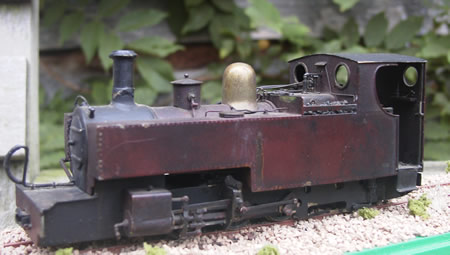
sadly, this loco was destroyed by one of our cats
The loco was replaced with a
Backwoods version, fitted with a ROCO outside frame chassis with Backwoods
cylinders and motion.
We chose this route as at the time of building we had not found a
competent Backwoods chassis builder and as usual, the chassis I built did not
work too well. The Backwoods version does not quite capture 'Russell' (a bit
like a Russell on anabolic steroids) but works fine for our freelance No1.
The loco ran extremely well for a while, until the usual Roco self
destruction mechanism kicked in, causing increasing oscillation until it
would almost fall off the track! It has now been rebuilt with a
professionally built Backwoods chassis by Rex Ashton and very well it runs
too.
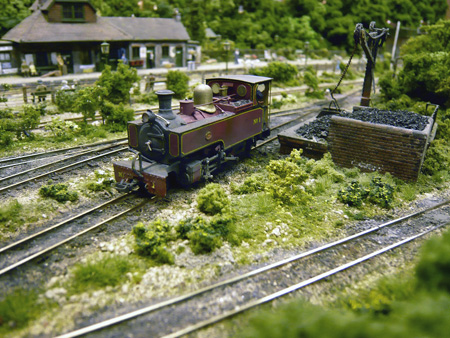
the newly built No. 1 built from a Backwoods kit. It is lined by
Tony Freestone
|
|
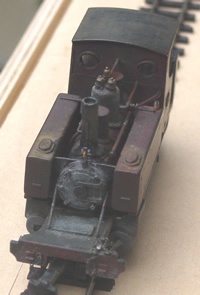
prior to rebuild
|
|
The Alco started out as a
white metal kit which was super-detailed but not fitted with a new outside
framed chassis. Until the time that this could be redressed, it lived in the
loco shed undergoing maintenance! Hey, how lifelike is this? Some locos
remain dismantled forever! The Alco has now been rebuilt by Pilton Yard. The
bunker was enlarged and new cab panels completed the picture. The
chassis was replaced by a Roco unit which ran very well for a short time
before it began to fail.
We have decided to withdraw
the Alco from service and place it in the scrap siding where it belongs.
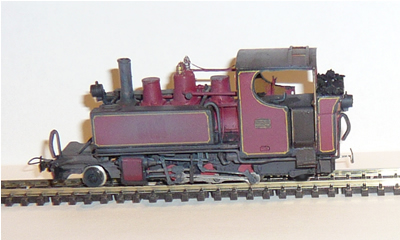
Happier days! No 6 after Pilton Yard rebuild but already a bit dirty! Sadly
no bar frames. Loco crew are not fitted as yet in this photo.

No 6...the final evolution
now with cab detail. It still awaits the fitting of chopper coupling prior to
being glued to the scrap siding - click on image to enlarge
|
|
The most unloved of the WHR locomotives, our Baldwin has a scratch built body
fitted to a Lilliput chassis. New valve gear was drawn, etched and fitted.
Unlike its prototype, this has been a very good running loco and actually ran
non-stop for one year at Caboose Hobbies in Denver on a fund raising layout. It has now been
re-motored. It is not possible to fit a flywheel to this model.
By modern day standards, the Lilliput chassis
runs very fast. This problem has been solved now the loco is converted to
DCC.
It is used as the top shunter but does get a run
on the line from time to time as it is still a very good runner.
It is ironic that our railcars often attract more interest than
our precious steamers. For the first few shows, we used the mainline railcar
No 200 to operate the shuttle between the harbour and County Gate. This would have been very unlikely as the
branch is a private line. We have now built the Glenthorne Harbour Authority
railcar which is again visually different both in shape and livery.

click on image to enlarge
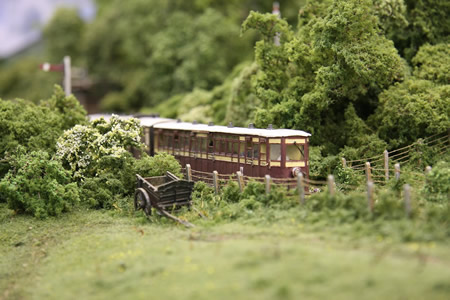
the railcar descends to the harbour
|
2-6-4 Baldwin No 2 'Ben Halliday' |
The Baldwin, (No 2) 'Ben Halliday' was delivered
just before Xmas 2008 and built up into a very fine good running loco.
It was a model of Sandy River No19 by Victors Models. Sadly, for us, the H0
scale of the loco, along with the fact that the prototype is a tad small
anyway, has meant that it is just too light to be able to haul a useful load
up the grades from the harbour branch.
The loco is now rebuilt as a 2-6-4 tank engine
using a Langley body fret. This has enabled much more ballast to be placed
over the driving wheels. The loco now pulls what is required of it. It has
working lights. The chassis runs very well but is a bit noisy.
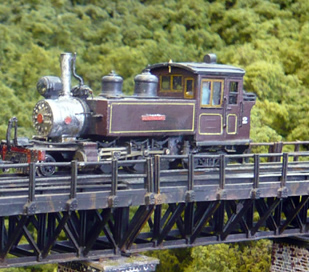
loco
No 2 'Ben Halliday'
|
0-6-0 0-6-0 No 2 Kitson Meyer |
There are a lot of advantages
to the Kitson Meyer design and if Kitson had been a better quality builder,
the Garratt type may well have been eclipsed. This is a scratch build project
based on two Bachmann class 08 chassis fitted with Roco valve gear.
|

|