|
Exhibiting: what is the next step?
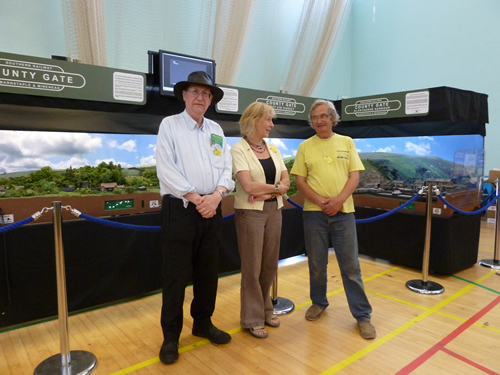
County Gate is nearly ready for another exhibition
Those who visit model railway exhibitions are a
very varied lot. A small number of folks are very bizarre indeed and turn up
time after time and can be both alarming and sometimes very entertaining.
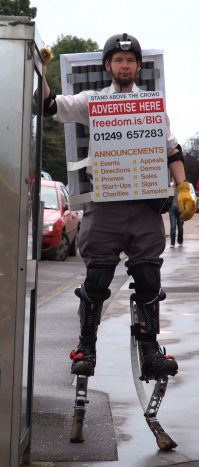
Obviously many exhibition visitors are already
model rail enthusiasts and have a clear agenda of what they wish to see but a
very large number of folks arrive with no more than a passing interest (if
any) in model railways. Are we doing enough to entertain these people? When
we have a line of spectators staring at our layouts, are there ways on
putting on a better show?
This has been the conundrum facing us at County
Gate. The layout is quite long (32ft) and it is not unusual to have visitors
four deep along the entire length. There is an awful lot of scenery with
trains running through it. It portrays just what we want: a small country
station on a single line minor railway. Often as not, folks do not even
notice the trains moving along the track as they are rather small in their
surroundings!
All the signals work correctly but again, they
are not always noticed. On larger layouts, it is just not possible to explain
verbally what is happening. So what could we do about it?
In reality, train movements on such a railway
would be infrequent, so firstly, we compress time. Two new trains cross at
County Gate every three minutes or thereabouts and in addition, a shuttle
service is run into the harbour. This at least promises a good chance that
the operation will be seen before the visitor leaves.
The sound levels at exhibition tend to be high
and loud sound from one layout will only annoy. We now have quiet ambient
sound for the countryside and for the harbour and visitors do seem to enjoy
birdsong and the occasional seagull or barking dog.
We also have whistle
and horn sounds for when the trains leave the station.
Most exhibitions supply a printed guide.
Exhibitors are asked to write a few words to describe their layout. This is
often all that the visitor will ever know about what they are looking at.
Pelmets and baseboard fronts
Many layouts do have pelmets over their railway
and some are used to add further descriptions of the model. Others attach
such information to the front of their baseboards. Occasionally, one sees
many photographs displayed with long and involved descriptions; all in small
writing. I wonder how often they are read in the hustle and bustle of an
exhibition.
We have printed simple further interpretation on
our pelmets and I notice that they are indeed often read.
supplementary guides
At a cost, one could produce a supplementary
guide to one's layout which could be available to the visitor either sold or
for free. This may work but frankly I rather doubt it.
Some inter-reaction could be had by providing a
quiz for children where winner get a small prize.
slide shows and 'mini movies'
A viable alternative is to use a screen or
series of screens visible
to the public. On this, a series of mini movies or slide shows could be shown
during moments when not much is happening on the layout. The history of the
railway, how the layout was built or how it is controlled are all possible
subjects.
This is an example
that I have prepared for County Gate.
Such shows can be easily initiated manually. At
County Gate, our Railroad and Co
software initiates them at the correct moments of the operating sequence.
This system also announces each train that arrives at the station.
This is an example
For a layout like County Gate, two screens would
be needed to allow all to watch. This is not cheap as the estimated price is
about £100 per screen.
cameras
Once such a system is in place, it is also
possible to incorporate cameras too. The activities on our rear fiddle yard
could be filmed as trains are automatically marshalled back to their sidings
and new trains dispatched (best not to get caught picking one's nose behind
the scenes though).
It could also be possible to show the layout
from angles that cannot be seen by the public. The possibilities are endless,
including the use of a miniature camera mounted on a train.
Some layouts make good use of animation. It may
be a seaplane with rotating propeller or could even be cars moving down a
guided road system. Our layout has a flickering bonfire and arc welding
light emanating from the engine shed. Again, the possibilities are endless and
must certainly add something to the show.
Our collier 'Glenthorne Rose' is fitted with a
large smoke generator. A computer cooling fan blow the smoke up the
chimney in a realistic fashion.
We are then, of course, presented with the
conundrum that parts of the layout are still, rooted in a moment of time,
while other bits are moving.
This is very obvious on our latest layout,
Cliffhanger. The waterfall is animated but the waves of the sea below are
still.
A number of European companies now supply moving
figures and cameos. Sadly, many are very robotic and if I see another
burning house with a fire crew, I shall scream. That is always the problem
with commercial animations.
Some layouts do fit Seuthe smoke units to their
locos. Personally, I am not convinced as they really do not look like steam
engine emissions to me. In addition, I am concerned that the smoke generating
oil would get all over the engines and scenery.
Given the right kind of layout, the lighting can
be gradually adjusted from day into night. This can be really very effective
indeed although not appropriate for our own County gate.
We have started to use smell. When trains arrive
at the station, a special oil burner blows out the smell of steam engines .
I am sure there are lots of other really good
ideas out there and hopefully, this article might get us all thinking. If by
improving our showmanship we can persuade newcomers into our hobby, everyone
will be a winner.
For some it may be possible to obtain the effect
of shadow from clouds passing over and back screen project onto the backdrop
could offer great effects.

|
